For couples
How to Write a Love Letter That Does Not Sound Like a Greeting Card
A structure, three example passages, and the traps to avoid — how to write a love letter in your own words, not the card aisle’s.
The Old Letters Editorial · · 6 min
Why a letter, not a message
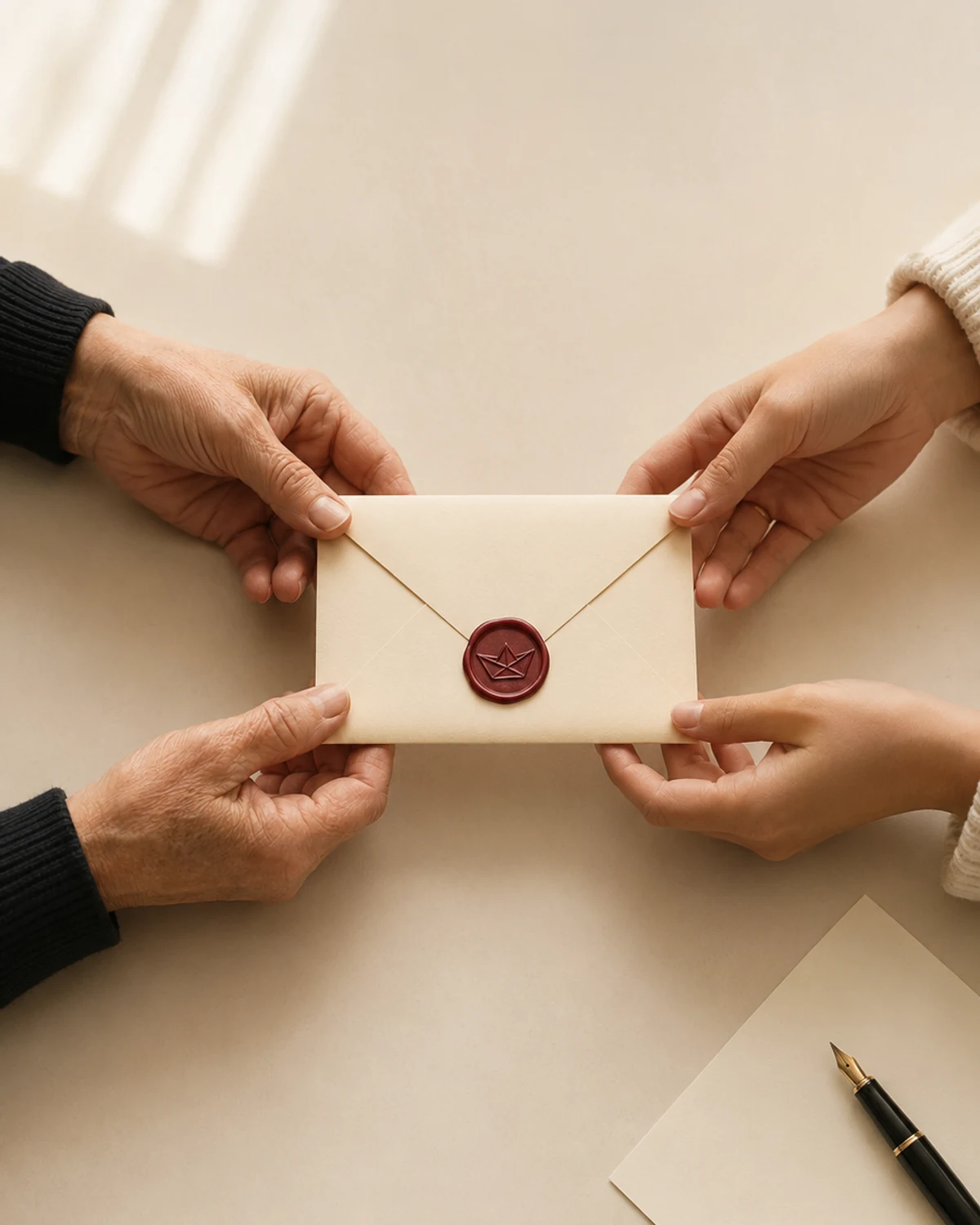
A declaration sent by chat lands between an order confirmation and a question about groceries. Not because it means less — because chat has no room for weight. A letter does. It asks to be sat down with, read start to finish, and kept.
A love letter does not need to be long or ceremonial. It needs to be yours. The entire difficulty is resisting borrowed words — the card-aisle lines, the song lyrics, the quotes — because borrowed words read as borrowed.
Before you write the first word
Recall three specific moments with this person: one ordinary, one difficult, and one nobody else knows about. You will not use them all. But a letter grown from specifics cannot sound like a template — a template has never met your moments.
Decide, too, why you are writing. “I love you” is a conclusion. The letter is everything that leads to it: for what, since when, despite what. One honest sentence answering “why this person” carries further than a paragraph of assurances.
A simple structure that does not constrain
Treat it as a handrail, not a recipe — there for the moments the ground gives way.
- Opening: the reason you sat down to write. No occasion required.
- A specific: one moment described so it can be seen — the place, the gesture, the sentence.
- The heart: the thing you do not usually say. Written plainly, without ornament.
- The future: one sentence about what you want next — together.
- Closing: a sign-off that sounds like you. Not “sincerely”.
Three passages that work
“I cannot say when it began. I know exactly when I noticed: you were standing in the kitchen explaining something with your whole heart, and I thought — I want to be listening to this voice thirty years from now.”
“You are not my calm. You are the reason the noise stopped mattering.”
“Thank you for all the evenings when nothing happened. Nearly everything we have is built out of them.”
Notice what these share: none of them says “always” or “everything”. Each holds one moment or one thought. Big words need a specific to stand on — otherwise they fall over on their own.
What to avoid
A few traps that are easy to walk into at speed:
- Quotes in place of your own words. If a quote is genuinely yours as a couple, weave it in — but do not let it open the letter.
- An inventory of virtues (“beautiful, brilliant, kind”) — a list of adjectives describes a product, not a person.
- Apologising for the writing (“I’m not good at this, but…”) — that is asking for leniency in the first sentence.
- Promises beyond your means. One keepable promise outweighs three grand ones.
When and how to deliver it
A love letter needs no anniversary — written for no occasion it weighs even more, because no calendar explains it away. If you are writing for an anniversary or Valentine’s Day, write early and let it rest overnight. In the morning you will fix two sentences and thank yourself.
Hand it over in person, leave it on a pillow — or schedule its delivery for the exact day it should mean the most. In The Old Letters, the letter content is encrypted on the sender’s device, and the server receives no readable letter body.
How to Start a Letter: 5 Opening Lines That Work · Letters for No Reason: What to Write When There Is No Occasion